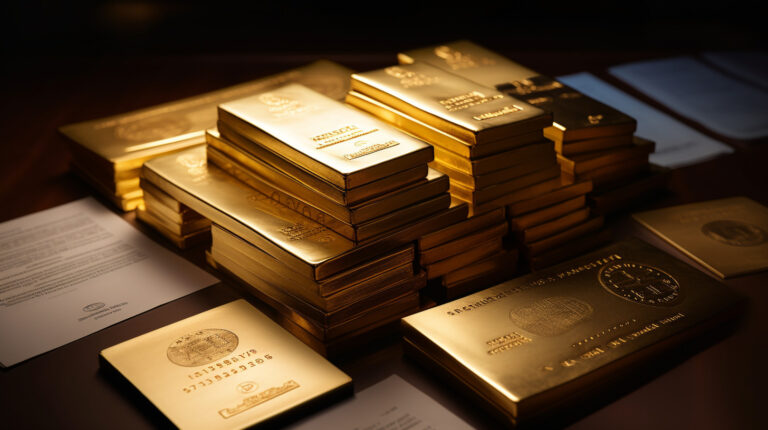
Eric Vazquez, a lineman for a power company in southwest Florida, says he’s holding a lot more gold than most financial advisers would recommend Gold Rises. Not just in his portfolio, but also in bars and coins spread between several secret locations.
Ensuring his wife and children go to bed at night in peace, Vazquez said, requires owning tangible assets, not just a claim on them through some exchange-traded fund.
It is a strategy for a world that he worries is growing more chaotic. The government keeps spending beyond its means
“At least in my adult life, nothing’s gotten better,” said Vazquez, who is 33. “And I just feel like I want to take as much of my own livelihood, my own safety, my own family’s safety, into my own hands.”
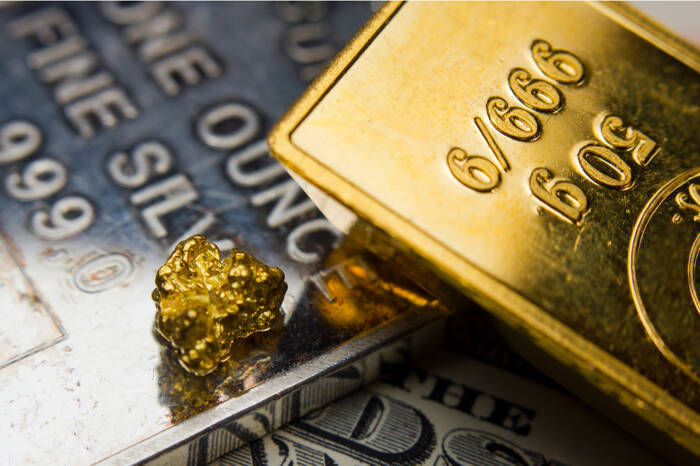
Worries about war, discord and mounting government debt have fueled a worldwide rush by individuals and institutions into what Wall Street calls “physical gold”— bars, coins, jewelry and nuggets. Widespread stockpiling has helped lift prices more than 40% since October 2022, to $2,367 a troy ounce.
Now, many think prices were boosted by legions of Chinese consumers. Nervous about their country’s shaky economy and seeking hard assets outside its collapsed property market, they recently have hoarded physical gold. Customs data showed the country racked up 194 metric tons of gold imports in March, a 40% increase over February and the biggest monthly inflow in at least seven years.
But people the world over are scooping up the precious metal. They are paying premiums to buy gold in Asia and the Middle East, Nicky Shiels, metals strategist at MKS PAMP, wrote in a note to clients last month. Costco’s business selling bullion is booming in the U.S. Worldwide demand for bars and coins, which are typically bought by individuals rather than institutions, grew by 36% between 2019 and 2023, according to the World Gold Council trade organization.

People tossing bars and coins into their shopping carts don’t usually have Wall Street-levels of concern about the path of monetary policy, analysts say. They often want something they can stash or carry, to shield themselves from potential catastrophes.
“There’s just growing uncertainty, whether it’s economic uncertainty or geopolitical uncertainty,” said Wilson.
Waves of new buyers emerged after the Covid market crash and last year’s regional banking crisis, said Alex Ebkarian, chief operating officer of precious metals dealer Allegiance Gold. More recently, new trade agreements between countries such as Russia and China have spawned anxiety about the U.S. dollar’s diminishing role in the world, prompting some investors to seek stability in the currency favored by the pharaohs.
“They’re asking themselves the what-if question,” said Ebkarian. “’What if the dollar continues to devalue? I don’t want to have all of my assets be paper based.’”
Hedge funds and other speculators have begun ramping up bullish futures and options bets. Doshi believes the financial market will catch up to the physical one, propelling the price of gold to $3,000 in the next six to 18 months.
“It might be that [the market’s] just realizing that ‘Hey, gold prices were probably too low,’” he said.
Soaring debt is one reason Barry Kitt buys gold. The Dallas-based 69-year-old said his calculations show it has beaten inflation since 1913 and the S&P 500 since 2000.
A former hedge-fund manager who now runs a family office, Kitt is comfortable with financial products and uses ETFs when he wants to trade quickly. Nonetheless, most of his gold is physical, including several large crystalline nuggets.
With ETFs, he said, “You don’t own gold, you own a piece of paper. I want to own it. I want to know it’s mine.”